The Second Coming Of The Lord
William Branham · Branham Tabernacle, Jeffersonville, Indiana · April 17, 1957
♫ Listen to or read the full sermon at Voice Of God Recordings →
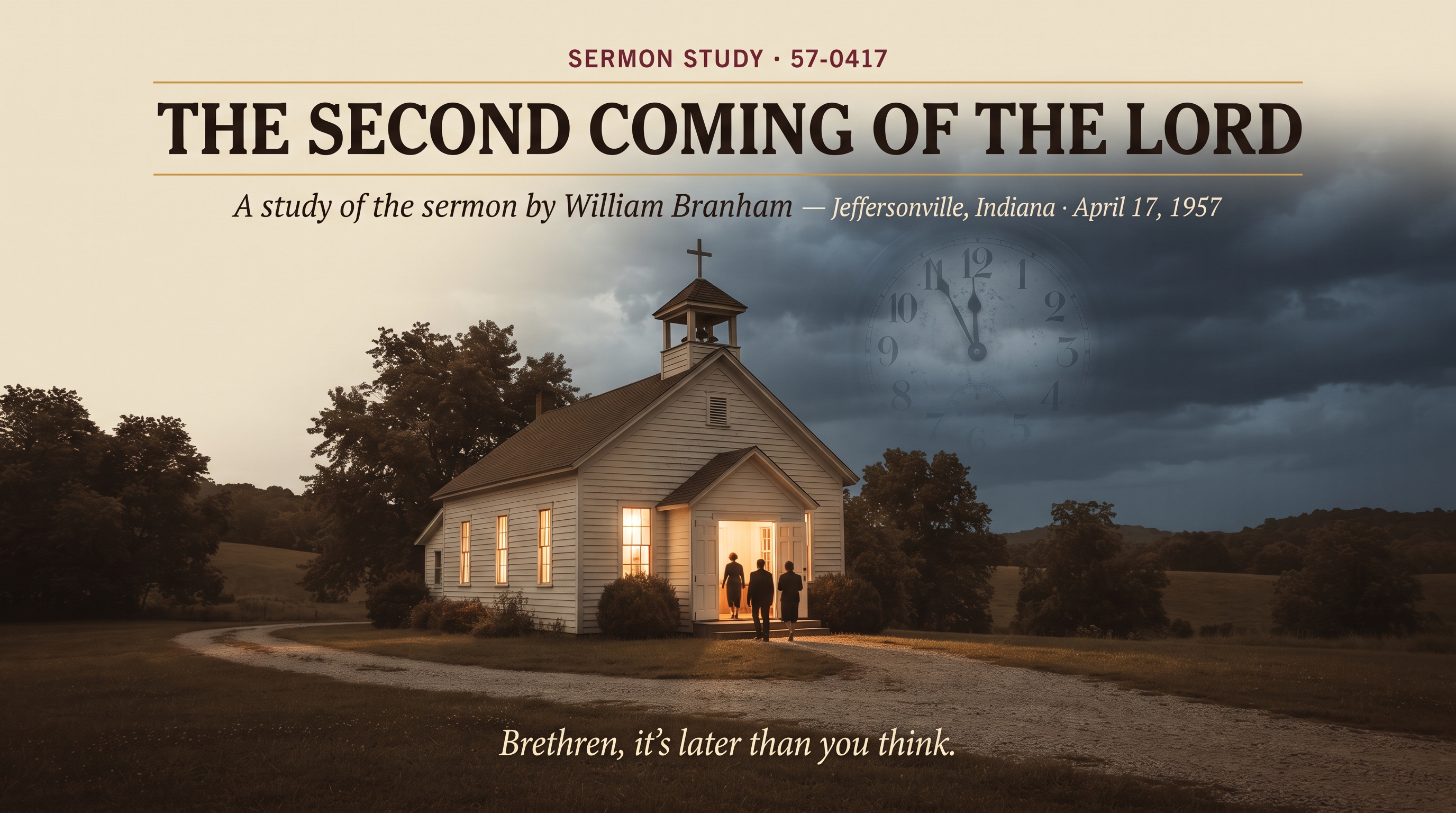
By 1957, Branham had spent a decade almost constantly on the road, but this particular night he's home, back at the little Branham Tabernacle in Jeffersonville, Indiana, fulfilling, in his own words, a promise he'd made eleven years earlier to eventually return for a revival. He opens warmly, calling out old faces in the crowd by name, admitting the building is far too small for what they're about to try and pack into it anyway. It's a homecoming before it's a sermon on the end of the world.
An Earthquake, In Person
Branham grounds his case for the nearness of the Second Coming in Matthew 24, wars, rumors of wars, earthquakes in divers places, but rather than simply citing the verse, he tells the room about being in Oakland, California, sitting in a barber's chair, when the ground actually moved under him. He describes the radio cutting in with an earthquake warning, walking the streets afterward with his wife as bottles fell from shelves and plaster cracked from the walls of thirty- and forty-story buildings. It's a small, human detail, an itinerant preacher and his wife caught in a real, physical tremor, used to make a two-thousand-year-old prophecy feel like it just happened to him personally, that week.
Reading the Cold War as Prophecy
The sermon then turns from geology to geopolitics. Branham points to the state of Israel, restored as a nation less than a decade earlier, and to the United States' shifting alliances in the Middle East, treating both as fulfillments of the promise that nations who bless Israel will be blessed and those who curse it will be cursed. Then he brings up something genuinely striking for a sermon from the pulpit of a small-town church: the Bulletin of the Atomic Scientists' actual Doomsday Clock, which by 1957 had been set to just a few minutes before midnight. He uses it exactly as intended, as a scientific, secular measure of how close the world's own experts believed humanity stood to self-destruction, and lays it directly alongside Sodom, Egypt's final night, and Pearl Harbor as further evidence that people rarely recognize their last hour while they're living in it.
A Preacher Reading the Newspaper
What's notable about this sermon, compared to some of Branham's more personal or visionary messages, is how much of his evidence here comes from ordinary current events, the newspaper, the radio, a magazine photo essay on the Doomsday Clock. He isn't claiming private revelation for any of this; he's reading headlines the same way anyone in the room could have read them, and asking the congregation to notice what he noticed. It's less "thus saith the Lord" and more "look at what's already right in front of us."
For Reflection
- Every generation since the apostles has pointed to its own wars, disasters, and technologies as signs of a soon coming end. What do you make of that pattern, does it weaken this kind of argument, or is it exactly what you'd expect if the signs really do accumulate over time?
- Branham uses a secular, scientific source (the Doomsday Clock) alongside Scripture to make his case. Where else in his preaching have you noticed him reaching for outside evidence rather than relying only on personal revelation?
- He opens by celebrating a homecoming to his own church after eleven years away, then pivots to warning that time itself may be almost up. How do those two moods, nostalgic joy and urgent warning, sit together in the same sermon, for you?
Source: The Second Coming Of The Lord, preached April 17, 1957, Branham Tabernacle, Jeffersonville, Indiana. Text © Voice Of God Recordings. This study is a paraphrase and personal commentary, not a reproduction of the sermon.
← Back to Sermon Studies