The Angel Of God
William Branham · Phoenix, Arizona · November 2, 1947
♫ Listen to or read the full sermon at Voice Of God Recordings →
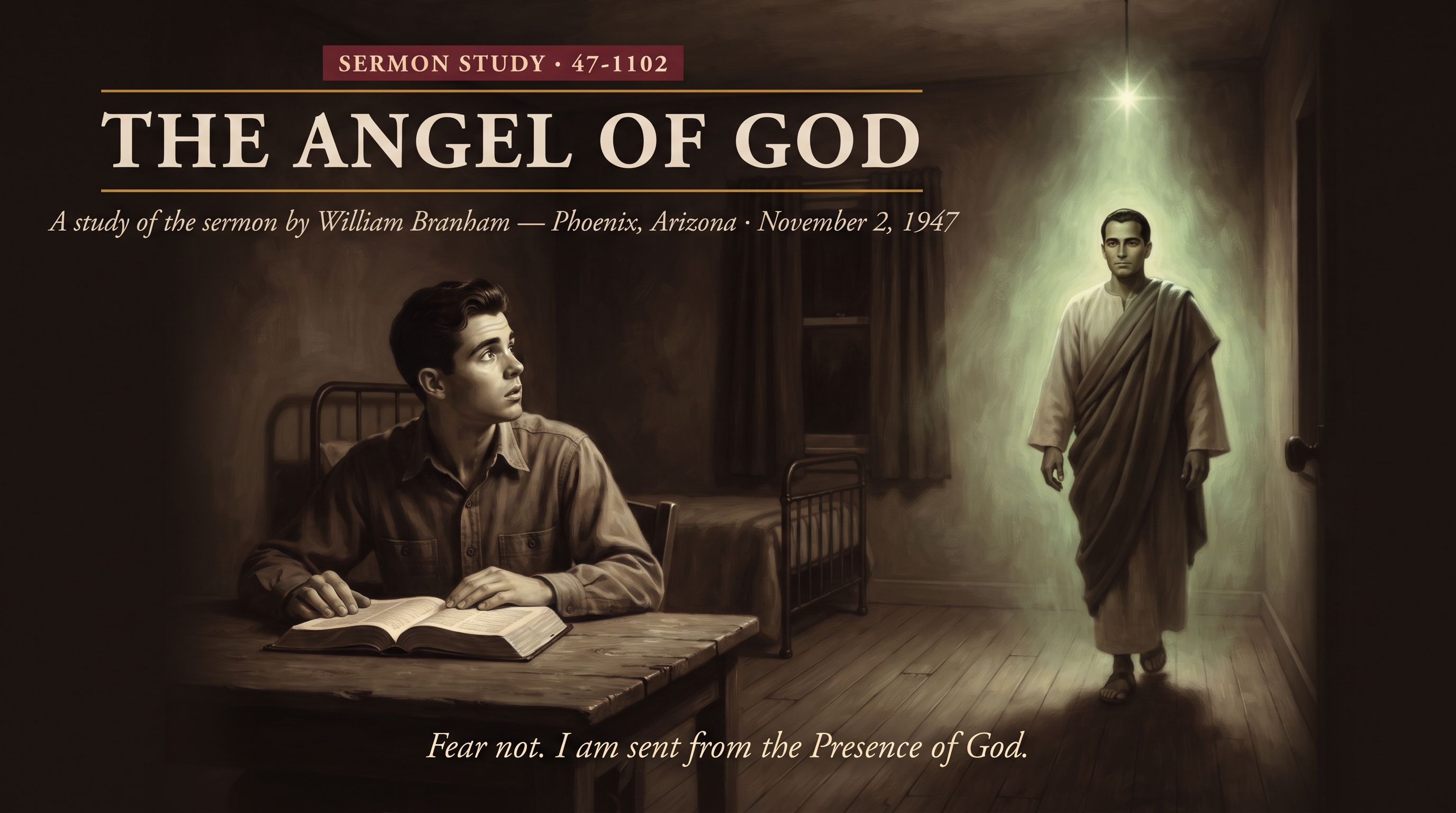
This sermon opens an eight-week campaign in Phoenix, Arizona, and Branham arrives at it fresh off what he calls the most powerful meeting of his life, in Calgary, a young man's healing so dramatic that his mother had pawned her wedding ring just to keep him at the meetings long enough to be prayed for. But the real center of this sermon isn't Calgary. It's a room, roughly two years earlier, where Branham says his entire ministry began.
The Room
Branham describes sitting alone reading his Bible when he first noticed a light he mistook for a car's headlights turning a corner outside. It didn't move on, it grew brighter. He heard footsteps, looked up, and saw a star hanging near the ceiling, casting a greenish-yellow glow across the floor. Walking through that light, he says, came a large man, olive-complexioned, dark-eyed, beardless, robe draped over one shoulder, who told him not to be afraid, said he was sent from the presence of God, and delivered what Branham took as his commission: that his unusual life and birth had been preparing him for a gift of Divine healing, that sincerity and the people's belief would mean no disease could stand before his prayer, and that he would come to know people's sicknesses, and eventually their sins, through a vibration in his hand.
Whatever a reader makes of the vision itself, it's worth noticing how plainly and specifically Branham tells it, not as vague spiritual impression, but as a scene with a location, a time frame ("a little over two years ago now"), physical description, and a direct quotation. That's the kind of claim that invites scrutiny, and Branham seems to know it; he tells it anyway, in front of a room full of strangers on the first Sunday of a new campaign.
"A Gift of Healing, Not a Gift of Miracles"
Branham is careful, here and elsewhere, to draw a distinction that's easy to miss: he insists what he has is a gift of healing, not a gift of miracles, and that the difference matters. His explanation of sickness itself is blunt and very much of its time, disease as a kind of "germ," and germs as a form of life, which he equates with what Jesus called a devil, meaning literally a tormentor. Whatever you make of the biology, the theological move is clear: sickness isn't neutral or accidental to him, it's something to be addressed the way you'd address an intruder, with authority and a command to leave, not just a request for sympathy.
Naming What He Couldn't Have Known
The sermon includes two accounts of what Branham frames as specific, testable foreknowledge. The first: a Catholic teenager from Sacramento, seated far back in a crowded meeting, silently hoping only that Branham would look at her so she could be healed, who he says he called forward by describing her hat and her seat, diagnosed with tuberculosis by name, and prayed for, sight unseen beforehand. The second is bolder still: mid-sermon in Phoenix, he describes a deaf stranger somewhere in that day's crowd and states, before the man has been identified or has come forward, that if he steps into the prayer line his hearing will be restored, adding, "if that isn't right, then call me a false prophet." That's not a hedge. It's Branham explicitly setting up his own claim to be checked against the outcome, in public, the same afternoon.
For Reflection
- Branham tells the room encounter with specific, checkable details rather than vague spiritual language. Does the specificity of a claim like this change how you weigh it, compared to a vaguer testimony might?
- He draws a firm line between a "gift of healing" and a "gift of miracles." Why might that distinction have mattered to him, both theologically and practically, in front of a skeptical crowd?
- Twice in this sermon, Branham states something publicly before it's confirmed, and invites the audience to hold him to it. What do you make of a ministry built on falsifiable, in-the-moment claims rather than claims that can only be evaluated later?
Source: The Angel Of God, preached November 2, 1947, Phoenix, Arizona. Text © Voice Of God Recordings. This study is a paraphrase and personal commentary, not a reproduction of the sermon.
← Back to Sermon Studies