Why Matthew Calls Her "Canaanite" Instead of Mark's "Syrophoenician"
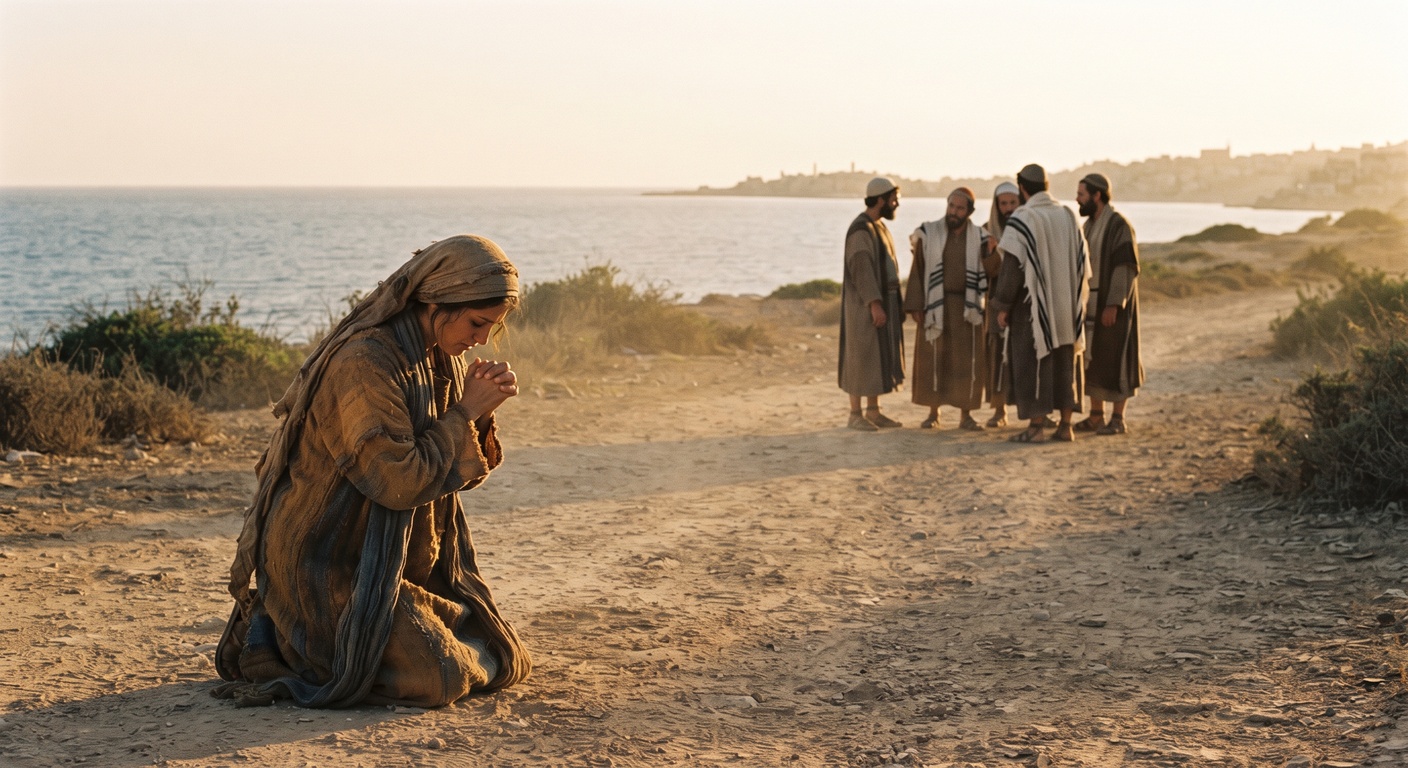
Two Gospel writers tell the same story: a Gentile mother comes to Jesus near Tyre and Sidon, begging Him to deliver her daughter from a demon. Matthew and Mark both describe the woman's nationality. Neither one is wrong. But they don't use the same word, and once you notice that, you can't unnotice it.
Mark calls her a Syrophoenician. Matthew calls her a Canaanite.
Two Accurate Labels for the Same Woman
By the first century, "Syrophoenician" was the term the wider Greco-Roman world actually used for people from this region. Rome had a province called Syria, and Phoenicia sat inside it, so "Syrophoenician" distinguished the local population from the other Phoenicians the Roman world knew well, the Libyphoenicians of North Africa descended from Carthage. It's precise, current, geographically exact. It's the term a Roman census-taker or a Greek-speaking traveler would have reached for without a second thought.
"Canaanite" is none of those things. By the time Jesus stood on that road, the word hadn't described anyone's actual nationality for centuries. Canaan wasn't a place on any Roman map. It was a name out of Israel's oldest history, the land promised to Abraham, the seven nations Joshua was commanded to drive out, the people whose idolatry and whose ancestor's curse in Genesis 9 had shaped Israel's entire self-understanding of who they were called to be, and who they were called to conquer.
Two Writers, Two Audiences
The difference isn't a contradiction to explain away. It's a window into who each Gospel was written for. Mark's audience was largely Gentile, likely centered in Rome, people who needed the woman placed on a map they recognized. Matthew's audience was steeped in the Hebrew Scriptures, people for whom the word Canaanite didn't need a map at all. It needed no explanation, because it already carried one, a thousand years of conquest, warning, and a curse spoken over Ham's son that Israel had grown up rehearsing.
Matthew had Mark's accurate, contemporary term available to him, or something like it, and chose the older, heavier word instead. That's not an error. That's a decision.
Why the Word Is the Whole Point
Read what happens next with that decision in view. This woman, carrying the name of the people under the oldest curse in the book, comes to a Jewish rabbi with more persistent, more theologically fluent faith than Jesus finds anywhere else in Israel up to that point in Matthew's Gospel. "O woman, great is thy faith," He tells her, the same commendation He gives the Roman centurion a few chapters earlier, another Gentile Matthew takes care to name plainly. The cursed line produces the greater faith. Matthew doesn't soften the label to make the story easier. He sharpens it, because the contrast between the word Canaanite and the faith this particular Canaanite displays is the sermon he's actually preaching.
That collision, between an ancient curse and a faith strong enough to reach past it, is the entire argument of Breaking Canaan's Curse. Matthew picked the one word in his vocabulary heavy enough to carry it.

This post draws directly on the full case made in Breaking Canaan's Curse: The Great Faith of the Gentile Woman.
Learn More Buy Now